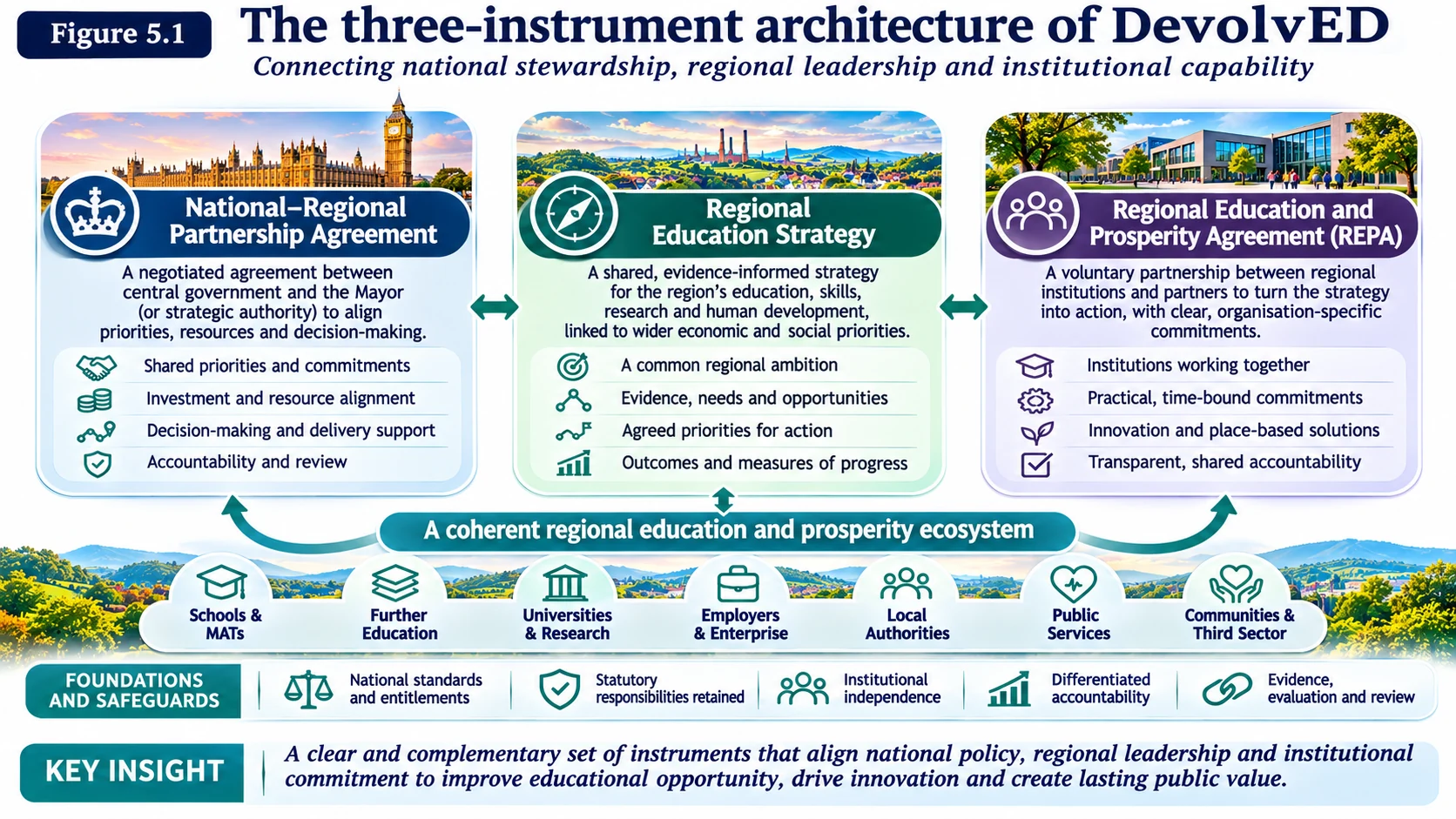
DevolvED proposes a way to connect national responsibilities, regional priorities and the independent contribution of institutions — without confusing who has the authority to decide what.
Strategy is not an agreement. And the two agreements are not the same.
These are proposed arrangements for examination, not adopted policies or signed agreements. Their distinct purposes are essential to the proposition.
01 · Shared direction
Regional Education Strategy
The regional ‘what and why’. A shared account of educational opportunity, regional strengths and priorities, informed by evidence and developed with institutions and communities.
Identify regional ambitions and inequalities
Connect learning, research, skills and prosperity
Set priorities and measures of progress
It is a strategy, not a transfer of statutory powers.
02 · National ↔ regional
National–Regional Partnership Agreement
The government-to-region relationship. A proposed agreement between central government and the relevant mayoral strategic authority, defining how they would work together.
Clarify respective powers and responsibilities
Specify resources, flexibilities and boundaries
Establish accountability, assurance and review
It would require the agreement of the relevant public authorities.
03 · Regional partners
Regional Education and Prosperity Agreement (REPA)
The partnership-for-delivery relationship. A proposed agreement among willing education, research, enterprise, civic and public-service partners about how they would collaborate.
Agree contributions and shared projects
Coordinate evidence, transitions and innovation
Set participation, governance and evaluation arrangements
Its content would be co-created following Discovery, not imposed in advance.
Illustration from the developing Proposition 2.5 paper. The detailed wording is still subject to editorial review.
How the relationships fit
Different levels of decision-making, connected by shared purpose
National governmentNational policy, statutory responsibilities, funding and accountability
↔
Mayoral strategic authorityRegional leadership, priorities and agreed devolved responsibilities
↔
Willing regional partnersUniversities, FE, trusts, employers, public services and communities
The National–Regional Partnership Agreement concerns the first relationship. REPA concerns collaboration among regional partners; it does not replace the legal responsibilities of government, local authorities, governing bodies or institutions.
A closer look
The National–Regional Partnership Agreement
English devolution raises a practical question: how might national stewardship and regional initiative reinforce rather than frustrate one another? The proposed National–Regional Partnership Agreement would provide an explicit basis for discussing that relationship, including the powers and responsibilities that remain national, any responsibilities or flexibilities agreed regionally, the resources supporting delivery and the mechanisms for scrutiny.
It would not automatically devolve school standards, safeguarding, admissions, SEND or other statutory duties. Those would continue to be governed by applicable law and any expressly agreed changes. The proposal is to examine whether clearer, reciprocal commitments could enable a more coherent regional approach while protecting national expectations and institutional independence.
Illustrative question for Discovery: Could government and a mayoral authority agree a more coherent approach to education-to-employment transitions, with transparent responsibilities, data-sharing safeguards, resources and measurable outcomes?
REPA: the partnership that makes collaboration real
A Regional Education and Prosperity Agreement would operate on a different plane. It is not a settlement between Whitehall and the region. It is a potential compact between institutions and organisations that choose to contribute to a shared regional ambition.
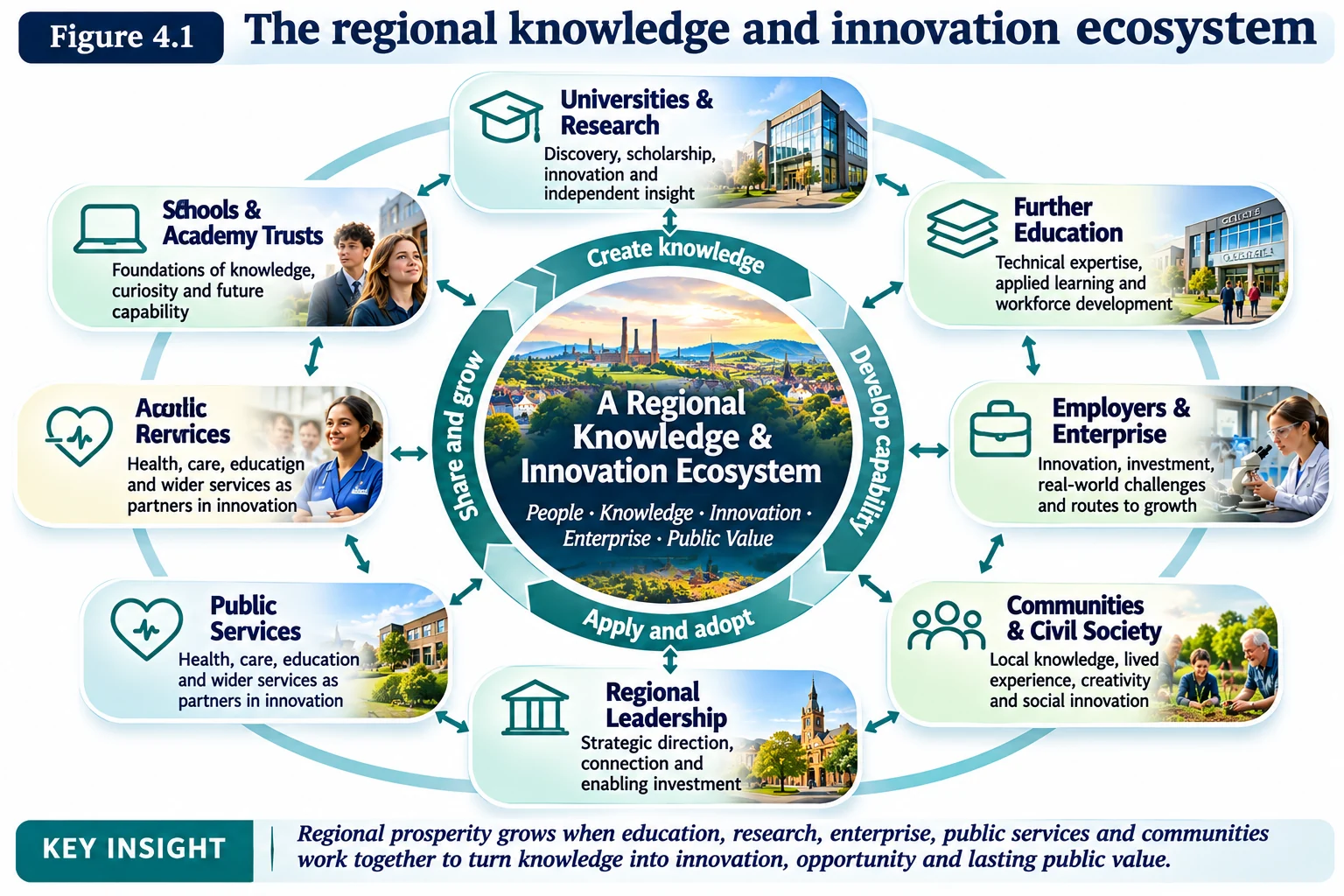
Schools and academy trusts, colleges, universities, employers, training providers, local authorities, public services and civic organisations would bring different capabilities and obligations. A REPA could establish how they coordinate practical work: learner transitions, research and innovation, place-based challenges, progression pathways, employer opportunities and shared evidence. It should also make clear who is accountable for each commitment, how participation is reviewed, and how partners can challenge or revise the arrangements.
Crucially, there is no pre-written REPA awaiting signature. A bounded Discovery process would first test whether the additional value justifies creating one. If so, willing partners would co-design its priorities, governance, responsibilities and evaluation.
The proposed regional partnership draws on distinctive institutional contributions rather than subsuming them into one body.
What this could mean in practice
Imagine a young person moving from school into further education, employment or university. A Regional Education Strategy could identify the need for better progression across the area. A National–Regional Partnership Agreement could clarify what national and mayoral partners are able to support. A REPA could bring together the organisations actually delivering opportunities and support, each acting within its own remit.
The test is additionality: Would these instruments enable better decisions, stronger cooperation and more opportunities than existing arrangements — without adding unnecessary bureaucracy? That is a question for evidence, not an assumption.
From idea to decision
Discovery first. Commitments only if justified.
The proposed sequence is an exploratory conversation, a short scoping phase, a bounded Discovery exercise and a decision gateway. Discovery should examine existing structures, legal constraints, institutional appetite, cost, public value and alternatives — including the option of strengthening current partnerships without new agreements.